Ask five contractors what it costs to build a four-bedroom house in Abuja and you will get five different answers, all of them defensible. That is not evasion. It reflects a real feature of construction in the Federal Capital Territory: two houses with identical floor plans, built a few kilometres apart, can differ in cost by a third or more.
Understanding why is more useful than memorising a figure. A number goes stale within months. The structure of the cost does not. What follows is a breakdown of the variables that genuinely move your budget in Abuja, so you can read any quotation critically and recognise when one is unrealistic.
Why cost estimates vary so widely
Construction costs in Nigeria are exposed to inputs that move independently of one another. Cement and reinforcement steel track global commodity markets and the exchange rate. Labour tracks local demand and the season. Haulage tracks fuel prices. A quotation prepared in March may need revision by August, not because anyone was careless, but because the underlying inputs moved.
This is why any figure quoted without a validity period should be treated with caution. A serious quotation states the date it was prepared, how long the pricing holds, and which items are provisional. A single lump sum with no breakdown and no expiry is not a quotation — it is a guess dressed up as one.
Land and site conditions come first
Before any construction cost applies, the site itself sets a floor under your budget. Location within the FCT drives land values enormously — a plot in Maitama or Asokoro carries a different order of cost from one in Lugbe, Kuje or Karshi, and that gap shapes what is economically sensible to build on it.
Site conditions matter just as much and are more often overlooked. A level plot with firm soil and road access is inexpensive to prepare. A sloping plot requires cut and fill, retaining structures and drainage. Soft or expansive soils require a deeper or reinforced foundation. Rock requires breaking. Poor access adds haulage cost to every load of material delivered.
- Topography — level, gently sloping, or steep
- Soil bearing capacity and water table depth
- Existing vegetation, structures or debris requiring clearance
- Vehicle access for delivery and concrete trucks
- Distance to mains services and drainage discharge points
Substructure: the part you cannot see or economise on
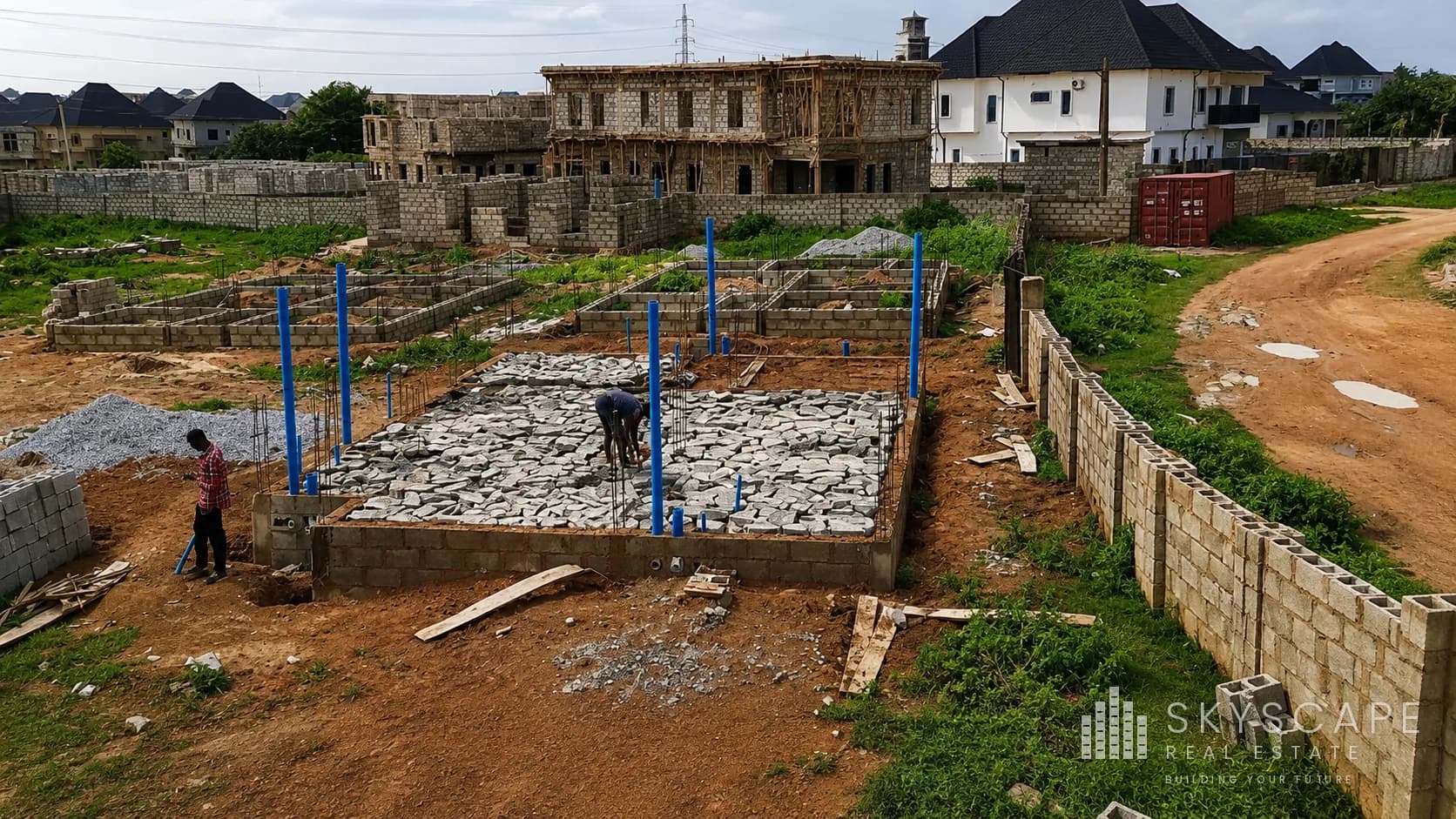
The foundation is where inexperienced budgets fail most often. It is invisible in the finished house, which makes it a tempting place to cut, and it is the one element that cannot be corrected later without demolishing what sits on it.
Foundation cost in Abuja depends almost entirely on ground conditions established by a soil investigation. A strip foundation on competent soil is comparatively economical. Poor bearing capacity may require a raft, or piles. The difference between these options is not marginal — it can shift the substructure from a modest share of the build to a substantial one.
A soil test costs a fraction of a percent of the project. Skipping it does not save money; it converts a known cost into an unknown risk that surfaces after excavation, when your options have narrowed and your programme is already running.
Superstructure and roofing
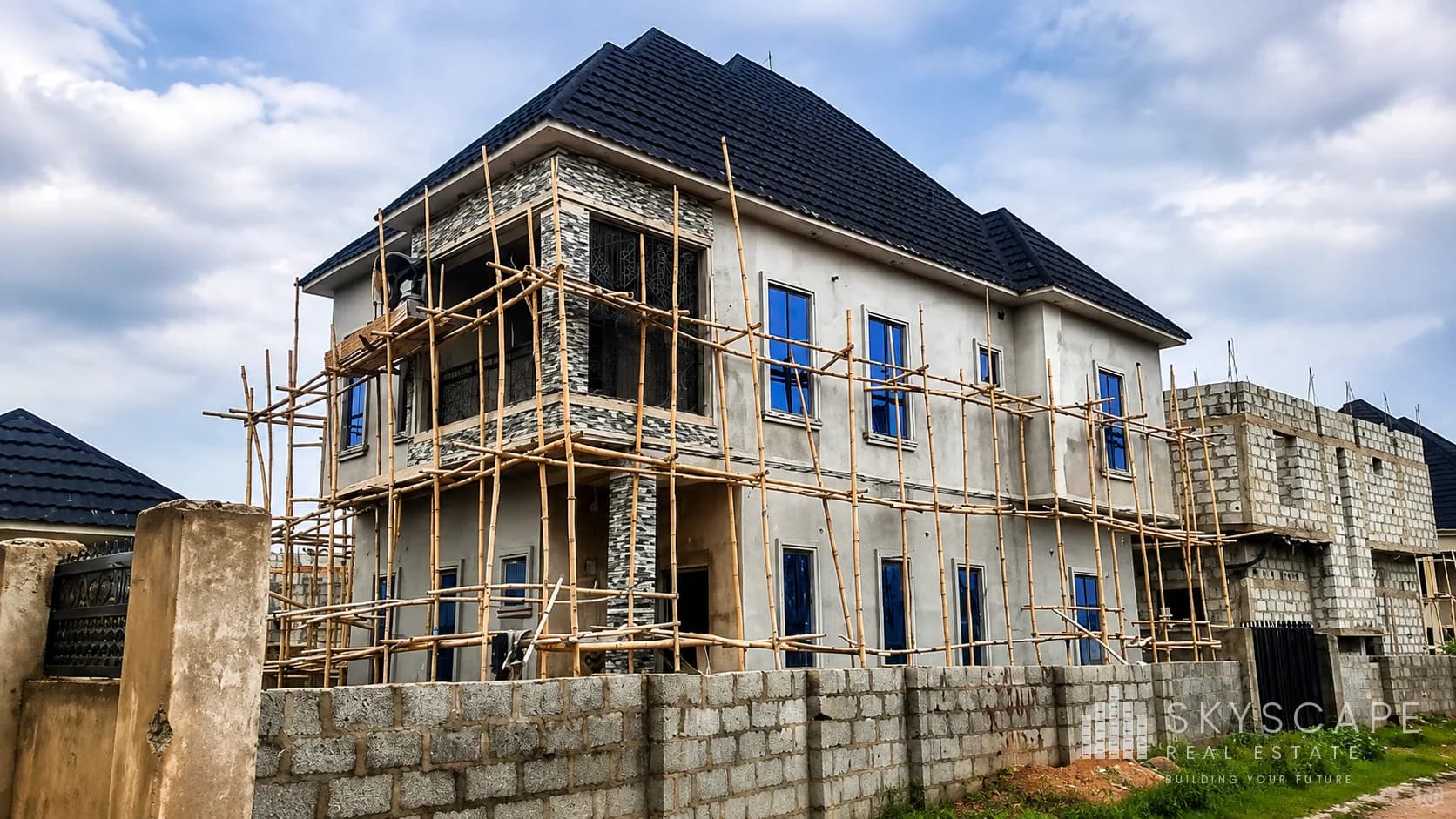
Above ground, cost is driven by geometry as much as by area. A simple rectangular plan with a straightforward roof is efficient. Every projection, recess, change in roof plane and double-height space adds material, labour and complexity — and complexity is where waste and rework accumulate.
Roofing choice carries both an upfront and a lifetime cost. Long-span aluminium performs well in the FCT climate and requires little maintenance. Stone-coated steel tiles cost more initially and are chosen largely for appearance. Cheaper sheeting saves money at handover and tends to return that saving as maintenance and replacement within a few years.
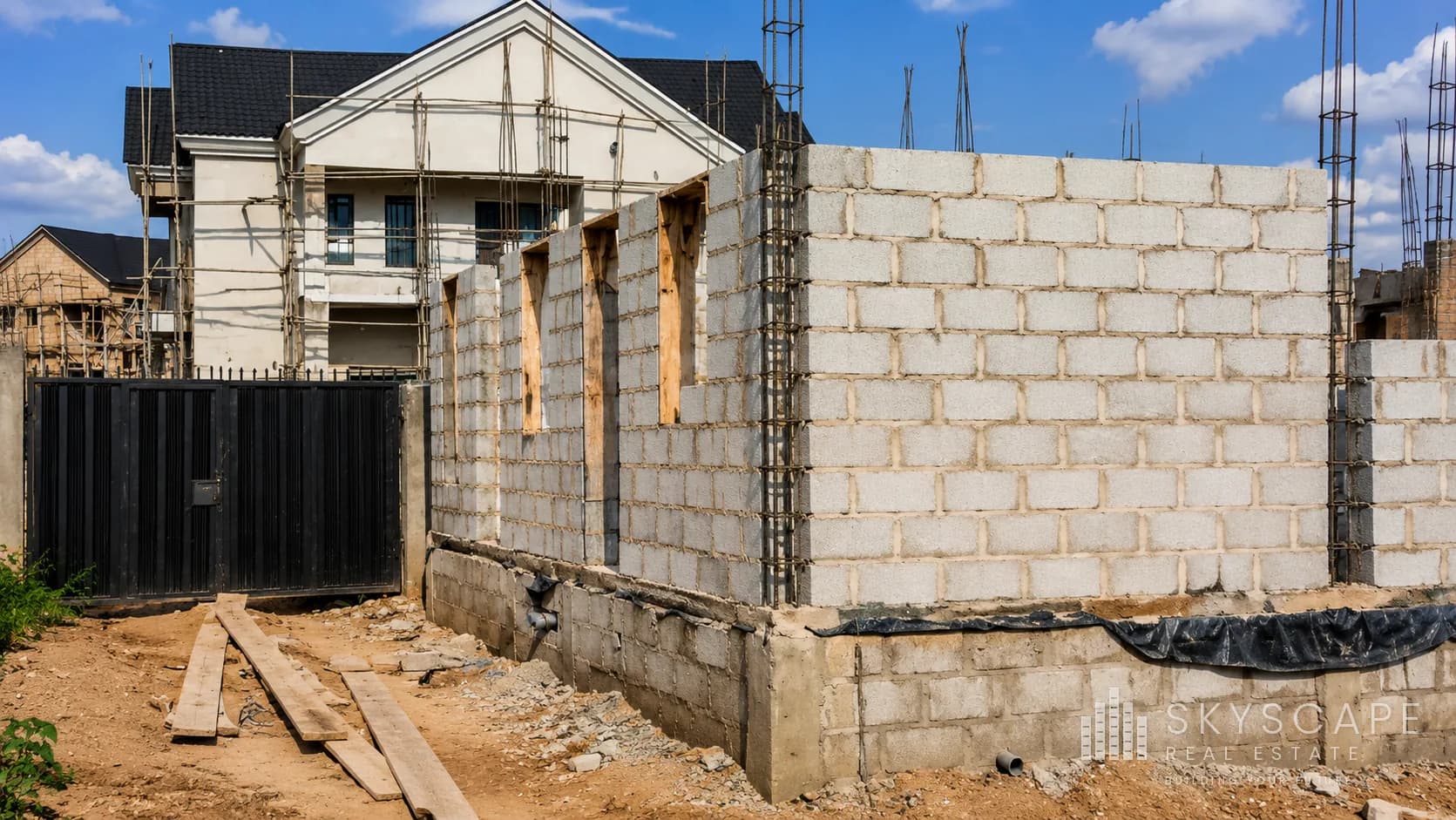
- Wall construction — sandcrete block is standard; alternatives change both cost and programme
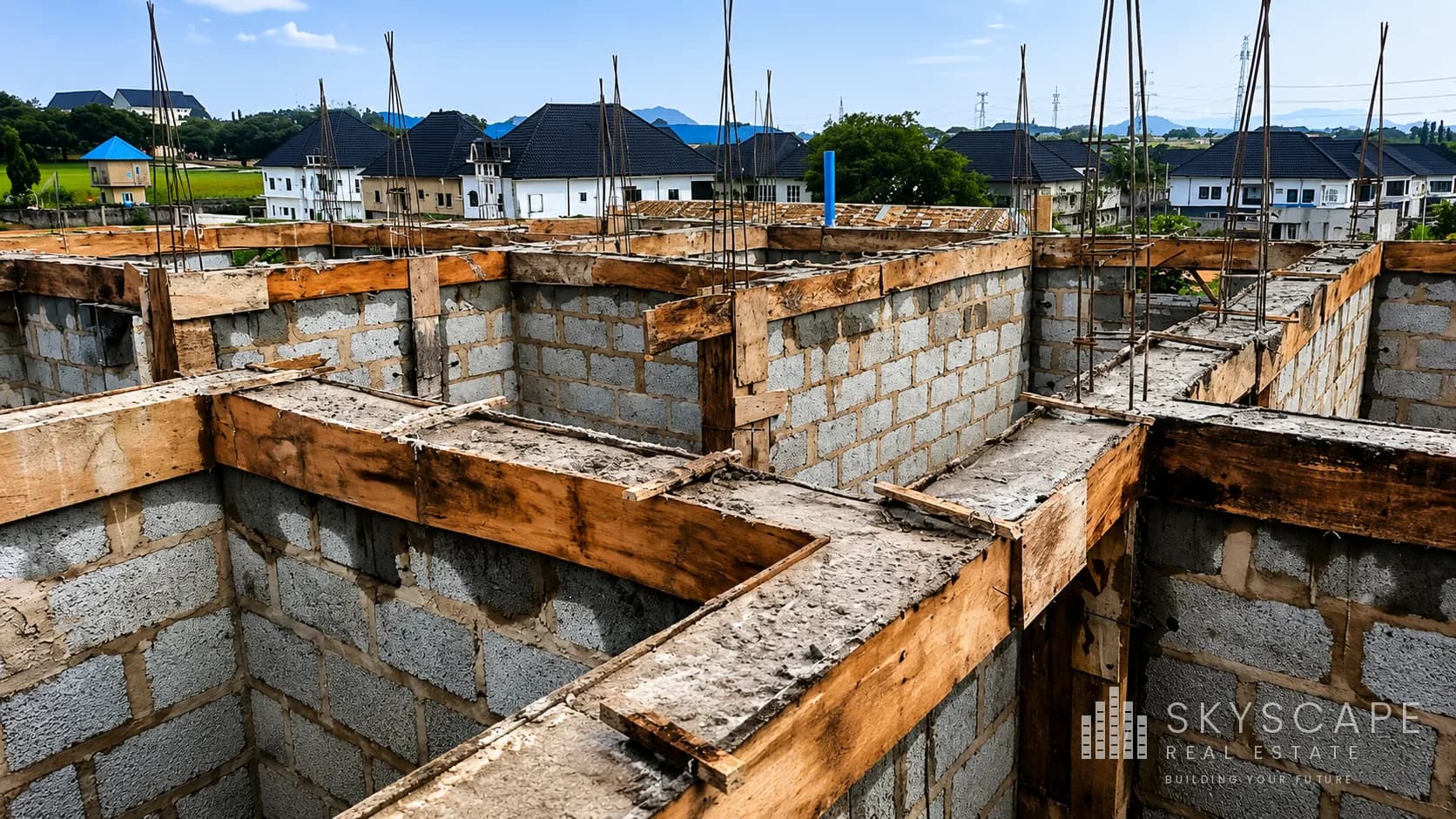
- Reinforced concrete frame — column and beam sizing follows structural design, not preference
- Floor slabs and staircases in multi-storey layouts
- Roof structure, covering, fascia and rainwater goods
Finishes: the widest variable of all
Finishes are where two identical structures diverge most sharply. Tiling, joinery, sanitary ware, ironmongery, painting, ceilings and fittings span an enormous range. The same floor area can be finished modestly or to a luxury specification, and the difference can rival the cost of the structure beneath it.
This is also the stage most exposed to scope creep. Decisions deferred to site tend to be made under time pressure, with limited comparison and weak negotiating position. Specifying finishes before construction starts — down to make and model where it matters — is one of the few reliable ways to hold a budget.
Services, professional fees and approvals
Mechanical and electrical services — wiring, plumbing, water storage and treatment, and increasingly solar and inverter provision — represent a meaningful share of a modern Abuja home. Standby power and water independence are practical necessities in much of the FCT rather than luxuries, and budgets that treat them as optional extras tend to be revised upward.
Professional fees cover architectural and structural design, quantity surveying, and supervision. Statutory approvals and development permits carry their own costs and, more importantly, their own timelines. Both are routinely omitted from informal estimates, which is a significant reason those estimates are exceeded.
Contingency is not optional
Every construction budget should carry a contingency. In a stable pricing environment a modest allowance may suffice; in a volatile one, more is prudent. This is not padding — it is recognition that ground conditions, price movements and design refinements are normal features of construction rather than failures of planning.
A project without contingency does not avoid these costs. It simply meets them by stopping work, which is the most expensive response available. Stalled sites deteriorate, secured materials walk, and remobilisation carries its own price.